

Warm White Bulbs Versus Cool White Bulbs
Why the Bulb You Choose Changes Everything
You can spend weeks choosing the perfect paint colour, then undo most of that work with a single bulb. Lighting is the most overlooked decision in a cosy home, and it is usually the one that decides whether a room feels like a retreat or a waiting area. Light sets the emotional temperature of a space before your eye even registers the cushions, the rug or the artwork. Swap one cool white bulb for a warm white one in a small sitting room and the whole space seems to soften, deepen and draw you in.
This guide is about the practical choice between warm white and cool white, and where each one genuinely earns its place in a home — particularly a compact one, where a single room often has to do three jobs before lunchtime.
Colour Temperature, in Plain English
Colour temperature is measured in kelvin (K) and printed on nearly every bulb box, usually in small print near the lumens. The numbers run counter to intuition: the higher the figure, the cooler and bluer the light. Think of a candle flame on one end of the scale and a bright overcast sky on the other.
- 2200–2400K — candlelight warmth. Very golden, ideal in bedside lamps and low table lamps.
- 2700–3000K — warm white. The everyday standard for living rooms, bedrooms and dining areas.
- 3500–4000K — cool white, sometimes called neutral. Crisp and clean, close to a bright cloudy day.
- 5000–6500K — daylight. Blue-tinged and clinical indoors; best kept for garages, workshops and outdoor security lights.
In UK homes, roughly nine out of ten rooms will look better at 2700K. The exceptions are the ones where you need to see exactly what you are doing.
Warm White: The Cosy Default
Warm white flatters skin tones, wood, brass, linen and just about every natural material you are likely to have spent money on. It also hides a multitude of small-space sins, because softer light blurs the edges of a room and makes tight corners feel intentional rather than cramped.
- Living rooms: 2700K throughout, ideally spread across a ceiling fixture, a floor lamp and a table lamp rather than one bright pendant in the middle.
- Bedrooms: 2200–2700K and dimmable. A bedside lamp at 2200K is the single easiest way to make a bedroom feel calm.
- Hallways and landings: 2700K. Narrow spaces benefit most from warmth, since there is little else to soften them.
- Dining areas: 2400–2700K, hung low over the table so faces are lit from above rather than glared at from the ceiling.
If you are layering light in a small room, keep every lamp within about 300K of the others. Mixing 2200K and 4000K in the same sightline looks accidental rather than designed.
Where Cool White Actually Works
Cool white gets a bad reputation, largely because it is used badly. At 4000K it is bright, honest and excellent at showing detail — which is exactly what you want in a utility space and exactly what you do not want over a sofa.
- Kitchen worktops: 4000K under the wall cabinets makes chopping safer and shows whether vegetables are actually clean.
- Bathrooms: 4000K over the mirror for shaving, tweezing and makeup, then warm white elsewhere in the same room.
- Home offices: 4000K at the desk keeps you alert and reduces eye strain on paperwork and screens.
- Utility rooms, garages and cupboards: crisp white light makes dark corners and small labels legible.
Anything above 5000K indoors tends to read as cold and slightly blue, which is exhausting in a room you are meant to relax in. A quick note on smart bulbs: many default to cool white when first switched on, so set your preferred temperature in the app on day one.
Styling a Small Space with Two Temperatures
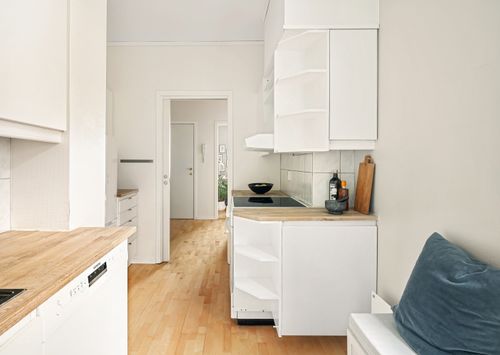
The trick in a studio flat, a box room or an open-plan kitchen-living area is to treat lighting as two layers rather than one compromise. Warm white forms the base layer and sets the mood; cool white is a task layer that switches on only when needed.
Keep them on separate switches, or separate smart bulbs you can control individually. In a small open-plan room, this means a warm pendant and floor lamp for the evening, plus a 4000K strip under the kitchen cabinets that you only turn on while cooking. The room reads as one warm space for most of the day, then becomes genuinely useful for the twenty minutes you need it to be.
One more thing worth knowing for tight rooms: lower the brightness rather than the temperature. A 400-lumen warm bulb in a corner lamp will make a small room feel bigger and calmer than a 900-lumen cool one ever will.
Buying Tips That Save a Return Trip
- Shop by lumens, not watts. Around 400–500lm suits a bedside lamp; 800lm is a sensible general bulb.
- Look for CRI 90 or above. A high colour rendering index keeps wood, fabric and food looking like themselves.
- Check the fitting before you fall in love. GU10 for spotlights, E27 or B22 for most pendants and lamps.
- Match dimmable bulbs to dimmable switches. Older leading-edge dimmers often buzz with modern LEDs; trailing-edge dimmers behave far better.
- Buy spares from the same batch. Two bulbs of the same kelvin rating from different production runs can look noticeably different side by side.
Get this one detail right and the rest of your interior scheme — the textures, the paint, the careful arrangement of a small room — will finally look the way you imagined it.
tag: Lighting

James Whitcombe Author
Painting the back of an alcove in a deeper shade can make shelves pop and turn a simple recess into a focal point.
YOU MAY ALSO LIKE
Painting Alcoves to Create Depth and Interest
Jun 26
10Choose a firm foam pad, measure the bay carefully, and sew a removable cover so the cushion can be washed when needed.
read more
Making a DIY Window Seat Cushion at Home
Jun 21
10Measure the recess carefully, add a slim desk and floating shelves, and use vertical space to create a focused work area.
read moreAlcove Ideas
-

ERRIC CATONA
Group books by colour, mix in ceramics and framed art, and leave breathing room so each shelf feels calm and considered.
May 19, 2016 at 5.12 pm
Reply
ERRIC CATONA
A bespoke bench with hidden storage makes the most of a bay, offering a comfortable spot for reading and watching the street.
May 19, 2016 at 5.12 pm
Reply -
ERRIC CATONA
Bay windows need flexible window dressings, so consider made-to-measure Roman blinds, thermal curtains or a combination that suits the room.
May 19, 2016 at 5.12 pm
Reply
Bay Windows
Your email address will not be published.